GRC Cement Component Industry Seeks Quality Upgrade in 2026,
Keywords: GRC component industry trend, molding materials for cement components, prefabricated architectural decoration, precision mold silicone, refined building material production, industrial cost reduction and efficiency improvement
Lead: In 2026, China’s GRC (Glass Fiber Reinforced Cement) component industry has entered a new phase featuring quality upgrading and green transformation. Driven by urban renewal projects and the development of prefabricated buildings and cultural tourism landscapes, the industry is moving away from extensive production models toward high-precision, low-loss and customizable refined manufacturing. As a high-end supporting mold material, liquid silicone rubber for cement component molding stands out with excellent detail reproduction, long service life and cost-saving features, serving as a core support to boost the standardization and efficient development of the GRC component sector.
The domestic architectural decoration and landscape building material market maintains steady growth in 2026. As a key material for European-style decorations, garden landscapes and prefabricated exterior wall ornaments, GRC cement components enjoy an expanding market. China remains the world’s largest producer and consumer of GRC products. With the implementation of green building policies, advancement of urban renewal, and construction of high-end cultural tourism landmarks, commercial complexes and premium residential projects, demand for custom-shaped, high-precision and durable cement components has risen sharply. This trend forces the whole industry to upgrade its production processes and supporting materials.
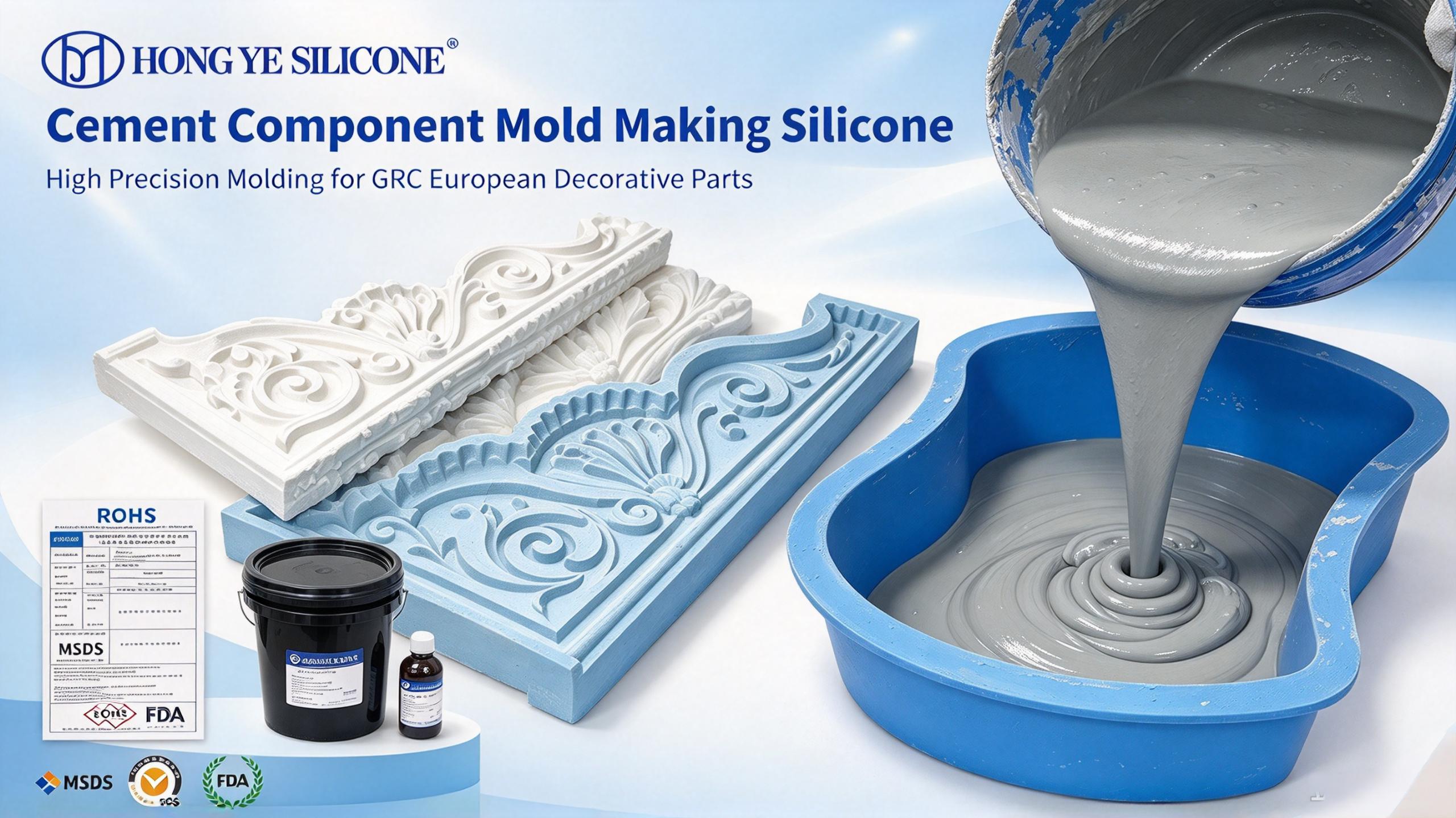
For years, the GRC cement component industry has been plagued by extensive manufacturing pain points. Conventional mold materials suffer from unstable hardness and poor texture reproduction capacity, making it hard to produce sophisticated European reliefs, special-shaped cornices and Roman columns. In addition, such molds have weak tear resistance and limited molding cycles. Frequent mold remaking increases material and labor costs, and may cause dimensional deviations and surface defects on mass-produced parts, resulting in high reject rates that fail to meet acceptance standards of high-end construction projects. Amid the trend of standardization and premiumization, low-end traditional mold materials can no longer satisfy industrial upgrading, creating strong market demand for high-performance molding materials.
Three major trends define the development of the GRC component industry in 2026. First, refined customization. Modern architectural designs pursue individuality and artistic effects, which greatly raise demand for complex curved surfaces, multi-layer reliefs and special-shaped linear components. Manufacturers are required to deliver cement parts with sharp textures, precise dimensions and smooth surfaces, putting forward strict requirements on detail replication of mold materials. Second, low-carbon mass production. Policies for prefabricated buildings and green building materials are being fully enforced. Reducing material waste and cutting mold remake frequency have become key methods for manufacturers to lower operating costs. Third, durable standardization. New industry codes impose higher requirements on anti-aging performance and long-term stability of outdoor building materials. Molds must produce cement components with consistent size and performance to withstand outdoor operating conditions.
Behind industrial upgrading lies technological innovation in supporting mold materials. Specially developed for GRC and precast cement products, liquid silicone rubber for cement component molding precisely addresses the pain points and trends of the industry, and has become a powerful tool for building material manufacturers to improve quality and efficiency. Compared with traditional mold materials, this dedicated silicone has moderate fluidity. It can fully fill tiny grooves and textures of various deep reliefs and irregular profiles, and replicate the original model at a 1:1 ratio. It effectively solves common problems such as blurred patterns, incomplete edges and rough surfaces of cement components, perfectly meeting the demand for high-end customized parts.
When it comes to mass production and cost control, silicone mold material shows prominent advantages. After curing, the silicone maintains good toughness and outstanding tear resistance. It can withstand the high stress during demolding of hard cement products without cracking or damage, greatly extending mold service life and molding cycles. Compared with ordinary mold materials, it can cut repeated mold-making costs by more than 60%. Meanwhile, the material features ultra-low linear shrinkage. Its dimension stays stable after curing, ensuring uniform specifications and consistent precision of cement components in batch production, reducing defective products from the source and helping factories achieve standardized mass production.
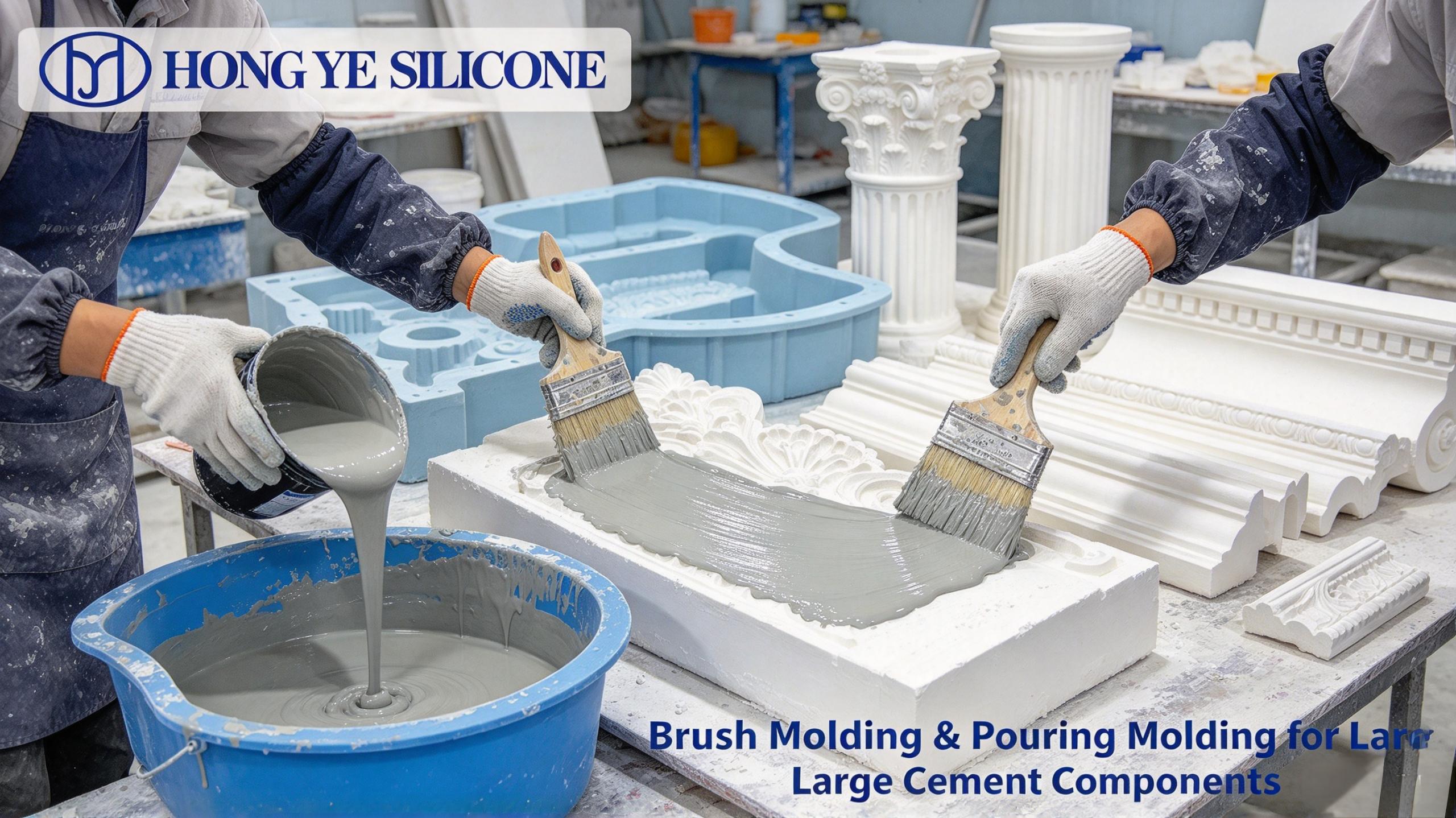
Its wide process compatibility makes it suitable for all kinds of building material production scenarios. The silicone supports two mainstream molding technologies: brush molding and pouring molding. It can be used to make split molds for large garden reliefs, long cornices and oversized Roman columns, and also for fast pouring molding of small precast components. It fits both flexible customization in small workshops and assembly-line mass production in large factories. Besides, it has great chemical compatibility and will not react with cement or GRC slurry. Demolding can be finished smoothly without adhesion. The formed cement parts require minimal polishing, simplifying production procedures and shortening delivery cycles.
Industry insiders point out that competition in the GRC cement component sector has shifted from price competition to comprehensive competition covering craftsmanship, product quality and cost control. As the carrier for component manufacturing, a mold’s precision, durability and stability directly determine finished product quality and enterprise profit. The popularization of high-performance cement component mold silicone effectively solves long-standing industry challenges including difficulty in refined production, high loss during mass production and inconsistent finished parts. It provides solid material support for the high-quality development of the industry.
Looking ahead, with the continuous popularization of prefabricated buildings, deepening urban renewal and expanding cultural tourism landscape projects, the market demand for high-precision and customized GRC cement components will keep growing. Technological upgrades of mold materials will continue to empower the transformation of the building material industry, pushing the GRC cement component sector from extensive mass production toward premium, low-carbon and standardized manufacturing, and helping China’s architectural decoration material industry enter a new stage of high-quality development.
 ∷
∷