Inhibition Prevention Becomes Essential
INTRODUCTION
Cure-inhibition failures are among the costly problems for gel users: a whole production batch of sealed filters or potted modules can be rejected when gel stays sticky, and root-cause searches often waste days. Chinese OEMs adopting addition-cure gel for the first time frequently lack this process knowledge, and suppliers who provide clear contamination guidance win trust and repeat orders. Hong Ye supports customers with detailed handling instructions, compatible-material lists, sample test protocols and responsive troubleshooting service, turning a common failure mode into a controlled, documented process. As gel use expands into new factories and industries, contamination-control education has become a core part of supplier value.
PRODUCT REQUIREMENTS
Contamination control requires: knowing the ten poison sources; using polyethylene, nylon or nitrile gloves instead of latex; dedicated tools cleaned of tin-silicone and epoxy residues; substrate testing before production (small-scale cure test); good housekeeping excluding cork, sulfur clay, PU volatiles and smoke; and a documented troubleshooting sequence when inhibition appears.
CORRESPONDING PRODUCT MODEL PARAMETERS
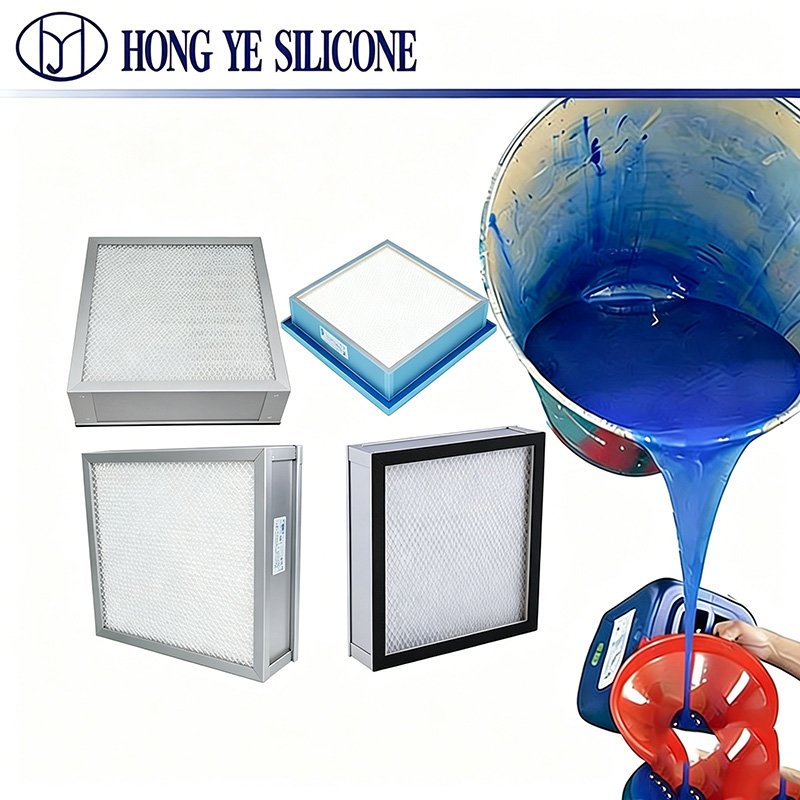
Recommended model: HY-9400 - Blue high-tack grade for HEPA/ULPA filter gel channels and cleanroom seals
|
Model |
Color |
Viscosity (mPa.s) |
Operation Time (min) |
Cure Time (hr) |
Penetration (0.1mm) |
Tack |
Mix Ratio |
Density (g/cm3) |
|
HY-9400 |
Blue |
1200+/-300 |
20-40 |
4-6 |
200+/-30 |
High |
1:1 |
0.98 |
GRADE SELECTION GUIDE
|
Model |
Color |
Penetration (0.1mm) |
Tack |
Typical Applications |
|
HY-9400 |
Blue |
200 |
High |
HEPA/ULPA filter gel channels, biosafety cabinet seals, applications requiring strong adhesion and re-sealability |
|
HY-9405 |
Blue |
170 |
Medium |
Electronic potting, sensor encapsulation, applications balancing softness and dimensional stability |
|
HY-9409 |
Transparent |
150 |
Low |
Transparent gel pads, intimate apparel, prosthetic devices, applications requiring visual clarity or easy repositioning |
FREQUENTLY ASKED QUESTIONS
Q: Why is my gel still sticky after 24 hours?
A: Either the A:B ratio was wrong or the platinum catalyst was poisoned by sulfur (latex, rubber), amine (epoxy, PU), tin (condensation silicone) or other contaminants; run a control cup and single-variable troubleshooting.
Q: Are nitrile gloves safe with addition-cure gel?
A: Yes. Nitrile, polyethylene and nylon gloves are safe; avoid natural rubber latex, which contains sulfur that inhibits platinum.
Q: Can I use the same mixing tools for condensation and addition silicone?
A: Not without thorough cleaning; tin catalyst residues from condensation silicone can inhibit addition-cure gel, so dedicated tools are strongly recommended.
QUALITY ASSURANCE & CERTIFICATION
Every batch of Hong Ye HY-94 series jelly gel is produced under ISO 9001 certified quality management in a dedicated silicone workshop, with incoming raw-material inspection, in-process mixing control and finished-product testing on every batch. Before release each lot is checked for viscosity, mix ratio, cure time, penetration, color and tack, and a Certificate of Analysis (COA) listing the actual measured values ships with every order. Standard grades carry RoHS 2.0 and REACH SVHC test reports; skin-contact and baby-care grades can be supplied with FDA 21 CFR 177.2600 and LFGB Section 30/31 reports and, on request, ISO 10993 biocompatibility testing; flame-retardant grades meet UL94 V-0. Food-contact, medical and export orders are supported by the corresponding compliance files for customer qualification. Hong Ye has manufactured and supplied jelly gel to contractors, filter builders and equipment makers in over 60 countries since 2005, with monthly capacity above 500 tons, batch traceability and multi-language documentation. Application engineers provide grade selection, sample evaluation, on-site or video pouring guidance and after-sales follow-up, and technical data sheets (TDS), safety data sheets (SDS) and test reports are available before order to support tender and audit processes.
CONCLUSION
The market for tank sealant jelly gel in this application area continues to expand as cleanroom construction, electronic encapsulation, automotive electrification, energy storage and consumer product manufacturing drive demand for reliable two-component addition-cure silicones. Hong Ye supports this growth with ISO 9001 certified production, 500-plus ton monthly capacity, complete compliance documentation and responsive application engineering. Buyers evaluating suppliers are advised to look beyond unit price and compare batch-to-batch consistency, documentation completeness, delivery stability and technical service responsiveness, because the cost of a sealing or potting failure - rework, downtime, certification delay or product recall - far exceeds the incremental cost of a quality gel. Choosing the correct grade for the channel, operating temperature and service environment, following the 1:1 mixing and pouring procedure and validating with a small trial batch all help secure a durable seal. Hong Ye welcomes sample requests and application enquiries; our engineers will recommend the HY-9400, HY-9405 or HY-9409 grade that matches the sealing or potting requirement and support qualification from first sample through volume production.
 ∷
∷