Winter Gel Sealing Practice for Filters in Extreme Cold Regio
INTRODUCTION
Cold-region construction seasons are short and schedule pressure intense, so contractors value materials and guidance that avoid winter rework. Gel sealing still outperforms gasket systems in winter because it tolerates ice-cold frame distortion and needs no torque-controlled compression, but crews need clear cold-weather procedures. Hong Ye supplies winter practice guides, heat-cure scheduling advice and packaging suited to unheated site stores, plus remote video support for first-time winter crews. As data-center and infrastructure construction pushes into colder climates, suppliers who document cold-weather capability win specification selection.
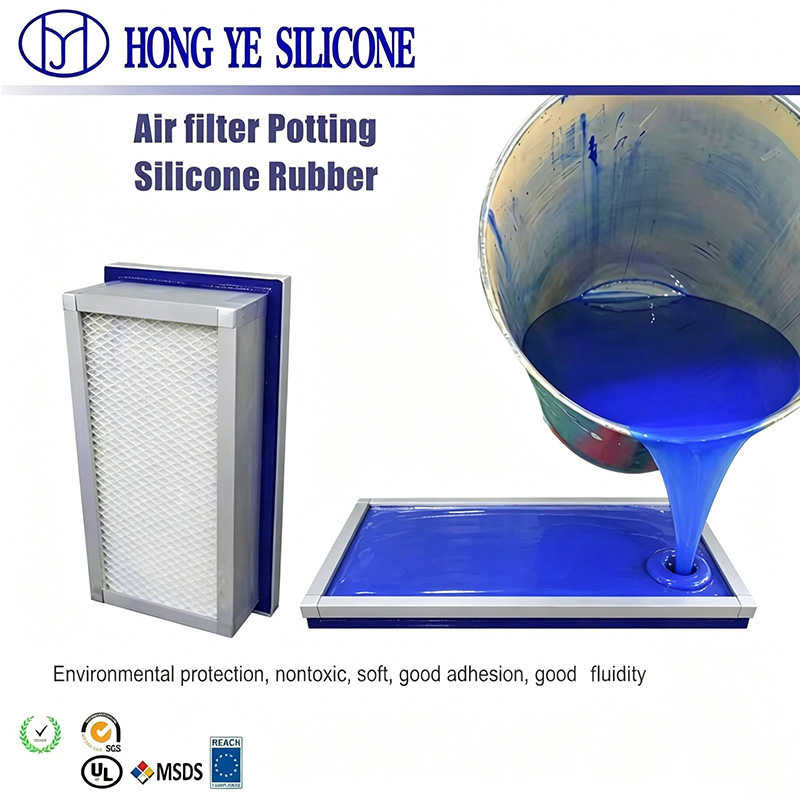
PRODUCT REQUIREMENTS
Cold-weather sealing requires: usable mix and flow at low ambient temperature; controlled slow-cure scheduling or heat acceleration; flexibility to minus 60C after cure; no freeze damage to uncured gel; warm-material handling procedures; and clear winter instructions for crews.
CORRESPONDING PRODUCT MODEL PARAMETERS
Recommended model: HY-9400 - Blue high-tack grade for HEPA/ULPA filter gel channels and cleanroom seals
|
Model |
Color |
Viscosity (mPa.s) |
Operation Time (min) |
Cure Time (hr) |
Penetration (0.1mm) |
Tack |
Mix Ratio |
Density (g/cm3) |
|
HY-9400 |
Blue |
1200+/-300 |
20-40 |
4-6 |
200+/-30 |
High |
1:1 |
0.98 |
GRADE SELECTION GUIDE
|
Model |
Color |
Penetration (0.1mm) |
Tack |
Typical Applications |
|
HY-9400 |
Blue |
200 |
High |
HEPA/ULPA filter gel channels, biosafety cabinet seals, applications requiring strong adhesion and re-sealability |
|
HY-9405 |
Blue |
170 |
Medium |
Electronic potting, sensor encapsulation, applications balancing softness and dimensional stability |
|
HY-9409 |
Transparent |
150 |
Low |
Transparent gel pads, intimate apparel, prosthetic devices, applications requiring visual clarity or easy repositioning |
FREQUENTLY ASKED QUESTIONS
Q: What happens if gel freezes before curing?
A: Avoid it: freeze can disrupt leveling and cure. Temper material and warm channels above 10C; if a pour freezes, remove and re-pour after warming.
Q: How long does cure take in winter?
A: At 10-15C expect 8-12 hours; schedule overnight cure or use 60-80C hot air for 30-60 minutes to keep fast schedules.
Q: Does cold affect the cured seal?
A: No. Once cured, the gel remains flexible and sealing down to minus 60C; cold only affects the installation window, not service life.
QUALITY ASSURANCE & CERTIFICATION
Every batch of Hong Ye HY-94 series jelly gel is produced under ISO 9001 certified quality management in a dedicated silicone workshop, with incoming raw-material inspection, in-process mixing control and finished-product testing on every batch. Before release each lot is checked for viscosity, mix ratio, cure time, penetration, color and tack, and a Certificate of Analysis (COA) listing the actual measured values ships with every order. Standard grades carry RoHS 2.0 and REACH SVHC test reports; skin-contact and baby-care grades can be supplied with FDA 21 CFR 177.2600 and LFGB Section 30/31 reports and, on request, ISO 10993 biocompatibility testing; flame-retardant grades meet UL94 V-0. Food-contact, medical and export orders are supported by the corresponding compliance files for customer qualification. Hong Ye has manufactured and supplied jelly gel to contractors, filter builders and equipment makers in over 60 countries since 2005, with monthly capacity above 500 tons, batch traceability and multi-language documentation. Application engineers provide grade selection, sample evaluation, on-site or video pouring guidance and after-sales follow-up, and technical data sheets (TDS), safety data sheets (SDS) and test reports are available before order to support tender and audit processes.
CONCLUSION
The market for tank sealant jelly gel in this application area continues to expand as cleanroom construction, electronic encapsulation, automotive electrification, energy storage and consumer product manufacturing drive demand for reliable two-component addition-cure silicones. Hong Ye supports this growth with ISO 9001 certified production, 500-plus ton monthly capacity, complete compliance documentation and responsive application engineering. Buyers evaluating suppliers are advised to look beyond unit price and compare batch-to-batch consistency, documentation completeness, delivery stability and technical service responsiveness, because the cost of a sealing or potting failure - rework, downtime, certification delay or product recall - far exceeds the incremental cost of a quality gel. Choosing the correct grade for the channel, operating temperature and service environment, following the 1:1 mixing and pouring procedure and validating with a small trial batch all help secure a durable seal. Hong Ye welcomes sample requests and application enquiries; our engineers will recommend the HY-9400, HY-9405 or HY-9409 grade that matches the sealing or potting requirement and support qualification from first sample through volume production.
 ∷
∷