How to Choose Pad Printing Silicone Hardness: A Complete Guid
In pad printing production, the hardness of pad printing silicone is one of the key factors affecting print quality. Different hardness levels result in significant differences in pad deformation, ink transfer, pattern edge clarity, service life, and suitable applications. Many companies only consider price when choosing pad printing silicone, neglecting the match between hardness and printing requirements, leading to poor print results, short pad life, and high defect rates. Shenzhen Hongyejie Technology Co., Ltd. (Hongye Silicone) shares a detailed guide to selecting pad printing silicone hardness. 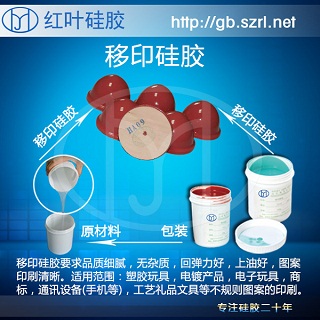
Pad Printing Silicone Hardness Scales
Pad printing silicone hardness is typically measured in Shore A, where higher values indicate greater hardness. Hongye Silicone's pad printing silicone series covers the complete hardness range from extra-soft to high-hard:
Extra-soft (15-18 Shore A): Like Hongye 916, very low hardness, extremely soft pads with strong deformation capability.
General-purpose (20-25 Shore A): Like Hongye 901 and 912, moderate hardness with wide applicability.
Medium-hard (26-30 Shore A): Like Hongye 902 and 918, higher hardness with good pad rigidity.
High-hard (above 30 Shore A): For special hard products and high-pressure printing.
Hardness selection depends mainly on product surface shape, pattern fineness, printing pressure, and product material.
Extra-Soft Pads: Characteristics and Applications
Extra-soft pad printing silicone (15-18 Shore A) is characterized by strong deformation capability, allowing it to conform well to irregular, curved, and uneven product surfaces. Because the pad is soft, it fully contacts every detail of the product surface during pressing, resulting in uniform and complete ink transfer. However, extra-soft pads lack rigidity, which can cause edge blurring and text distortion when printing fine text, and they have relatively lower wear resistance and shorter service life.
Suitable for: Curved products, irregular products, uneven surfaces, soft plastic products, large-area pattern printing. Examples include spherical toys, curved housings, soft rubber products, irregular gifts. Hongye 916 is the representative extra-soft product.
General-Purpose Pads: Characteristics and Applications
General-purpose pad printing silicone (20-25 Shore A) is the most widely used hardness range, balancing deformation capability and rigidity. It can adapt to certain curved surfaces while ensuring pattern clarity. Wear resistance and service life are at moderate levels with high cost-effectiveness. For most routine pad printing products, general-purpose silicone meets the requirements, making it the first choice for entry-level and routine high-volume production.
Suitable for: Flat products, small-curvature products, regular-size patterns, medium-fineness text. Examples include plastic toys, stationery, small hardware, electronic parts, promotional gifts. Hongye 901 (economical) and 912 (general wear-resistant) are representative products in this range.
Medium-Hard Pads: Characteristics and Applications
Medium-hard pad printing silicone (26-30 Shore A) is characterized by good pad rigidity and minimal deformation. During printing, the contact area between the pad and product is stable, ink transfer is precise, pattern edges are sharp, and details are clear, making it especially suitable for fine text, thin lines, barcodes, and QR codes. Additionally, medium-hard pads have better wear resistance and longer service life, suitable for long hours of continuous production. However, medium-hard pads have limited deformation capability and are not suitable for curved or irregular product printing.
Suitable for: Flat hard products, fine text, detailed patterns, high-precision marking, barcodes and QR codes. Examples include electronic components, instruments, precision hardware, medical devices, mobile phone accessories, eyeglass frames, watch parts. Hongye 902 (wear-resistant) and 918 (precision printing) are representative products in this range, with 918 optimized for precision printing and superior edge sharpness.
High-Hard Pads: Characteristics and Applications
High-hard pad printing silicone (above 30 Shore A) produces very rigid pads with minimal deformation. They resist deformation even under high printing pressure, suitable for high-pressure, large-area printing and hard product surfaces. However, high-hard pads have poor conformability and can only be used for completely flat products with high surface flatness requirements. High-hard pads offer the best wear resistance and longest service life.
Suitable for: Completely flat hard products, large-area patterns, high-pressure printing. Examples include metal nameplates, hard plastic boards, flat glass and ceramics.
How to Select Hardness Based on Printing Requirements
When selecting pad printing silicone hardness, follow these steps:
Product surface shape: Curved, irregular, or uneven surfaces choose extra-soft (15-18A); flat or small-curvature choose general-purpose (20-25A) or medium-hard (26-30A); completely flat choose high-hard (above 30A).
Pattern fineness: Fine text, thin lines, barcodes, QR codes choose medium-hard (26-30A), like Hongye 918; regular patterns choose general-purpose (20-25A); large-area patterns choose extra-soft or general-purpose.
Product material: Soft products (soft rubber, silicone, TPR) choose slightly harder pads to avoid poor contact when the pad is softer than the product; hard products (metal, hard plastic, glass) can be selected based on pattern fineness.
Printing pressure: High-pressure printing choose harder pads to avoid excessive deformation; low-pressure printing can choose softer pads.
Volume and life requirements: High-volume continuous production with high pad life requirements choose medium-hard or high-hard; small-batch, multi-variety production can choose general-purpose.
Common Hardness Selection Mistakes
Mistake 1: Softer is always better. Not true. Extra-soft pads conform well but produce blurry fine text and have short life, not suitable for all products.
Mistake 2: Harder is always better. High-hard pads are wear-resistant but can cause incomplete contact and missing patterns on curved products.
Mistake 3: One hardness for everything. Different products require different hardness pads. It is recommended to keep 2-3 hardness levels in stock and select flexibly.
Mistake 4: Freely adjusting hardness with silicone oil. Adding silicone oil lowers hardness but also reduces wear resistance, ink pick-up, and printing stability. It is recommended to directly select the corresponding hardness model rather than adjusting with silicone oil.
Hongye Silicone Full Hardness Range
Hongye Silicone offers a complete pad printing silicone series from extra-soft to high-hard, meeting diverse printing needs:
916 Extra-soft (15-18A): First choice for curved and irregular products
901 Economical (23A): Entry-level routine production, high cost-effectiveness
912 General Wear-resistant (25A): First choice for routine high-volume production
902 Wear-resistant (25A): High wear resistance, long life
918 Precision Printing (28A): Fine text and detailed patterns, sharp edges
928 Addition-cure (adjustable hardness): High-end precision printing, food-grade certified
The company provides professional selection guidance and technical support, helping customers choose the most suitable pad printing silicone hardness based on product characteristics, improving print quality and reducing production costs.
 ∷
∷